Wednesday, September 03, 2008

vacations

The last summer vacation was a bit short, at least relative to the European standard, taking two non-consecutive weeks. However, it is impressive how much variety you have access to in a very short travel time here. It all comes down to distance which seems to be compressed in Europe, and with Switzerland right in the middle of it (at least geographically speaking, since the political integration has not progressed much!), we can enjoy a lot of small weekend getaways.

I can't help but compare this with Canada... when I was about 18, I took a train ride of about 42 hours which took me from Montreal to Regina (roughly 2400 km). During all this time one could only witness two types of landscape (forest and prairie) and a single culture, english canada!

Being totally unfair and bias, this is what I get when looking at all the places I've visited in Europe during my first stay in 2000-2002:

- Algarve in Portugal
- France (Paris, Lyon, the Alpes region, Provence and Côte d'Azur)
- Spain (Madrid, Barcelona, Alicante, Seville, Valence)
- Baviere region in Germany (Munich)
- Italy (Aoste, Piedmont, Lombardie regions)
- England (London, Wales)
- and of course a lot of regions in Switzerland (Romandie, Suisse Alémanique, Tessin)

All these trips offering such a diversity of culture within less than 1000km (except probably south of Spain and Portugal which are a bit further)!

However, now with the kids we are less ambitious ... actually we can reach places within less than 2 hours drive away from home... the exact time before our kids stuck in the car start their rampage! So that is what we did this summer.


Here are some pictures of these trips.

Enjoying the small boat in the lake Du Bourget at Aix-les-Bains.


Here is my mom and sister with the kids while visiting Gstaad.


Eating out at Thoune with my daughter!

From Juillet - Aout 2008 - partie 2


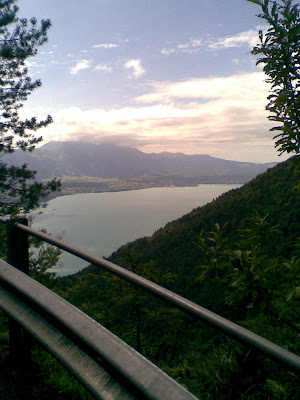
I did also quite a bit of biking .. with my longest ride from Lausanne to Bern or about 100km. My longest ascenscion, I did near Thoune (actually between Thoune and Interlaken) where I climb about 1400m.


Next pics were taken about half way toward Beetenberg and Nierderhorn.


You feel lucky to go through this tunnel knowing the quality of road in Switzerland, it was so dark the only thing visible is the small spot of light at the end of tunnel.


Actually the highest altitude road usually winds upward (lacet in french) quite smoothly... they are not nearly as challenging as city roads I regularly ride in and around Lausanne (I guess the logical explanation to this is related to accessibility during winter). For example, a small road I often take has average slope at 20% that rides up to reach "Les trois Chasseurs" from Pully-la_Rosiaz.

From From-mobile-phone


BTW, the pictures taken while riding are from my 2 Megapixel Nokia6300, not too bad for a crappy and old mobile phone!


Martin

Sunday, August 03, 2008

Gruyères

Ce blog a pris une tournure plus personnelle depuis notre arrivée en Suisse, ceci en grande partie pour tenir au courant ma famille de nos escapades. J'ai donc décidé que ma mère (Normande Lapointe, la mamie assez bien branchée et à la page en ce qui concerne l'internet) qui profite normalement bien de ce blog, pourrait maintentant y contribuer en écrivant un petit blog-photo le temps d'une balade! Je lui cède donc le clavier. (Martin)

Quel plaisir pour moi de relater brièvement notre excursion au château de Gruyère en cette magnifique journée du 2 août 2008, lendemain de la fête nationale suisse ! Un ciel bleu agrémenté de quelques nuages, une douce brise, de magnifiques montagnes en toile de fond, voilà comment s'amorce notre visite. Des conditions gagnantes, quoi !


Voici une vue du château de Gruyères prise par ma petite-fille Laurie qui, à six ans, manifeste déjà des talents de photographe.


Le château de Gruyères est un des plus prestigieux de Suisse, il est perché sur une colline dans un paysage verdoyant au coeur des Préalpes fribourgeoises (à 830 m d'altitude). Il domine la cité médiévale de Gruyères (nom qui dérive de la grue héraldique). L'histoire dit que 19 comtes y ont habité du XIe au XVIe siècle. Michel, le dernier comte de Gruyères, connut de grandes difficultés financières et fit banqueroute en 1554. Le territoire fut alors partagé entre les créanciers : les villes de Berne et Fribourg.


En compagnie de ma belle-fille Kim et de mes deux petits-enfants, Laurie et Mathias, nous montons vers le château.


On est presque arrivés... Voici le passage et les fortifications du Belluard, accès principal de la cité de Gruyères
Nous franchissons les portes.


En famille, devant une partie du Calvaire qu'on aperçoit à moitié derrière.


Au coeur de la petite place en bas du château... devant Le Chalet, maison qui a été construite ailleurs et récupérée ici.


Mathias devant une ouverture qui nous donne un aperçu des montagnes environnantes.


Quel visage radieux ! Le clocher de l'église de Gruyères nous apparaît derrière Mathias.

Vue de la montagne sous un autre angle.


Laurie fait une petite moue, le paysage est toujours époustoufflant.


Laurie, heureuse dans les bras de son père.


A l'intérieur du château, elle se prend pour un chevalier.


Nous voici dans la salle des baillis. Le château fut le siège des baillis fribourgeois de 1555 à 1798, après la faillite du dernier comte de Gruyères. Ceux-ci y ont laissé leur marque en aménageant des intérieurs baroques.


Mathias et Laurie sur le poêle en catelles (tuiles en céramique dans le langage populaire suisse-romand).


Laurie prend des airs de comtesse !


Une galerie avec vue... Le cours d'eau derrière moi est la rivière Sarine, bassin du lac de la Gruyère artificiellement créé suite à la construction du barrage de Rossens, donnant naissance au plus jeune lac de toute la Suisse!


Nous nous promenons dans le jardin français aménagé derrière le château.


La belle Kim, en plein centre ville.


Notre visite tire à sa fin. Nous flânons encore un peu dans la rue bordée de magasins de souvenirs et de restaurants. On est ravis de notre visite mais on a le sentiment d'avoir à peine effleuré des siècles d'histoire.
Peut-être reviendrons-nous un jour...

Normande

Monday, July 07, 2008

Thermalp Ovronnaz

Ce weekend j'avais réservé une journée surprise pour ma petite vieille! Et oui Kim a eu 38 ans la semaine passée et avec tout ce stress accumulé avec les années, rien de tel qu'une fin de semaine passée aux bains thermales accompagnée de soins divers!


Le site d'Ovronnaz se trouve à une heure de la maison en prenant l'autoroute qui longe le Rhône dans le Valais.


Petite parenthèse écolo:


  • Dans le Valais, on croise les plus puissantes éoliennes de la Suisse, fait assez rare en Suisse car le pays commence à peine à développer ce secteur. Il faut dire que les grands vents se trouvent plus en altitude et que j'imagine assez bien l'opposition des gens à gâcher ces magnifiques paysages alpins avec de gros ventilateur! La zone située à Collonges est particulièrement bien placée car il y a un phénomène de vent constant dû à l'encaissement de la vallée. La vallée du Valais située entre les plus hautes montagnes de la Suisse a d'ailleurs des caractéristiques météorologiques très différentes du plateau de la Suisse, comme le foehn et son très faible taux de pluviométrie (même quantité de pluie que Barcelone). D'ailleurs, j'ai bien remarqué ce minuscule plan d'eau qui semble idéal pour la planche à voile.... je vais peut-être considéré une reprise de ce sport qui n'est pas évident à pratiquer autour de l'arc lémanique. Le Léman est plutôt une cuvette avec peu de vents thermiques contrairement à d'autres lacs dans les alpes comme le lac de Côme.


Les enfants nous ont forcément rejoint plus tard dans la journée avec comme espoir de se baigner dans le "gros bain en forme de piscine".


Quant à moi, je me suis aussi réservé un peu de "détente" en grimpant les petites routes qui montent en laçais vers les haut sommets autour du village d'Ovronnaz! La monté fût assez pénible mais l'arrivée en valait le détour.


Je me suis finalement arrêté à la buvette Loutze à plus de 1700 mètres d'altitude. Je me sens maintenant prêt pour un vrai col!!


Martin

Sunday, June 22, 2008

Le barrage d'Emosson

Aujourd'hui nous nous sommes payés une petite visite en hauteur pour se rafraîchir par ce temps caniculaire (plus de 33C en plaine...). Nous avons opté pour Le Châtelard situé dans le Valais à deux pas de la vallée française de Chamonix.


A partir de ce petit village, nous avons pris le plus abrupte funiculaire à deux cabines de monde avec une pente maximale de 87% (ce qui donne à peu près 41 degrée! ... présumant que mes quelques souvenirs de la trigonométrique soient justes ).


Laurie au moment du départ, en plein confiance?


Nous parcourons par la suite un petit trajet à flanc de côteau en train à la vapeur fonctionnant au charbon.


Ce parcours nous offre une vue imprenable sur le Mont Blanc et ses sommets avoisinnants (on voit très bien les pics des Aiguilles du midi).


Nous arrivons à un 2e funiculaire qui lui nous mène au barrage du lac d'Emosson (à poids voûte).
Ce barrage avec sa hauteur de près de 200 mètre impressionne et donne le vertige! Il est le 2e plus gros de la Suisse en terme de volume d'eau retenu avec plus de 227 million de mètres cubes d'eau (la Suisse compte pas moins de 160 barrages ... ce qui me semble pas mal compte tenu de sa taille).


Voici quelques autres photos...


Et non nous n'avons pas adopté 2 nouveaux enfants, mais plutôt fait le voyage avec un couple d'amis avec enfants!


Coup de chance en me rendant dans une zone plus isolée pour prendre quelques photos, j'aperçois un chamoix qui ne semble pas trop appeuré de notre présence! Mon fils l'est un peu plus et nous le laisserons tranquille dans son jolie coin de pays: "papa, on ne devrait pas trop l'approcher... il a quand même des cornes!!"


Petite déception, nous n'avons pas pu atteindre les empreintes de dinosaures malgré toute la bonne volonté et motivation de Mathias.... la fatigue a tout simplement eu le dessus!!! À une prochaine fois.


Les enfants se sont montrés bien brâves et tenaces avec ces longs parcours, ces dénivellés et ascensions ... rien de mieux que d'avoir des amis de leurs âges pour stimuler leur orgeuil!!


Martin

Sunday, June 08, 2008

Claire Ouellet

This is a shameless blog-plug!

My sister Claire Ouellet, is a professional pianist. Although, I was sort of annoyed by it while I was younger (these continuous and endless practices caused me a few nervous breakdown!), I must admit that all these long years of discipline did pay off. She is now a teacher at the Conservatoire of Montreal, and her last record out is a hot seller (ok, ok... selling statistics for classical albums are certainly not on the same scale as pop music, so I'm not expecting her to move to Montreux soon ;-).

Here's her most recent album: Orford Six Pianos with details here.

Previous albums can also be found at

- Stravinski & Bartok: two pianos
- Invitation à la danse
- Nostalgia


Martin

Friday, May 30, 2008

Technology adoption rate in corporate world

Corporations are usually slow in adopting new technology internally... there is usually strong resistance usually among employees to change old habit (the famous comfort zone) or upgrade application implementation barely meeting requirement and specification. A good illustration of this is the too often seen requirement with spec similar as "files X containing all needed info will be sent to Mr. Y mailbox at some specified time schedule".

The email messaging paradigm is still the most natural and the least controversial way for disseminating information to specific recipients among the organization. However, many drawbacks are related to this approach:
  • The publisher application must manage all recipient emails (additions, removals, modifications, etc)
  • The publisher application is also responsible in managing temporary substitution among recipients email (e.g. with vacations, etc..)
  • Sending a large number of messages to various different recipients increase complexity of the publishing application whose scope should focus on the generation of the information
  • Email messaging is less practical for larger data volume content
  • Lack of security: the data sent over mailing application is rarely protected
  • Recipient mailbox is not resilient to failure (e.g. limit space exceeded) resulting in the end-user missing valuable new content delivery
Email used as the communication channel of type Application-to-EndUser, is very frequent everywhere, although a much better and flexible solution exist. RSS feed: RSS stands for Really Simple Syndication. Without going into too much details RSS feed (aka RSS channels) is a mechanism to allow any end-user to receive asynchronously some form of message (e.g. headlines, updates) or even data content published periodically by a provider. The end-user utilizes a RSS Reader (aka RSS aggregator) to stay up to date with new content published without having to know and worry about the publishing schedule. Simple RSS aggregators are directly available inside common web browser and more advanced ones are also available for free.

Some commonly uses of RSS feed include:

  • Notification of new data content within a web site (either just a summary or the full content), typically used by weblogs and news websites.
  • Notification of the arrival of new products in a store.
  • Listing and notifying you of newsletter issues, including email newsletters.
  • Notification of additions of new items to a database, or new members to a group.
  • Weather and other alerts of changing conditions.
Advantages of RSS:
-sophisticated security model can be implemented with RSS by leveraging the web security rules and mechanisms available in the company intranet/portal ;
-the management of all different messages content to all different recipients are off loaded from the publisher responsibility into the individual end-user recipients (except for security which can be managed at the web page level).... allowing the publisher to focus on the data content instead of delivery concern;
- Publisher application has a more standard and accepted way to publish and disseminate ad-hoc type message content (report, data, news, etc,,) among the end-user community within the organization.


Also interesting is the possibility that RSS can offer to corporate intranet and portal: RSS in the intranet. Some people even suggest RSS as a replacement of the email, as a way to get it over with the spamming issue or other shortcomings such as not being able to embed video within email directly.

Martin

Sunday, May 18, 2008

Sel des Alpes

Et oui, le sous-sol de la Suisse ne contient pas trop de pétrole mais on y trouve du sel! En fait, dans une autre ère géologique (200 million d'années.. ces échelles de temps m'apparaîtront toujours inconcevables??), la mer se trouvant sur ce territoire s'évapora et le sel laissé par cette évaporation se trouva pris sous le plissement de la formation alpine.

En jugeant de l'effort qu'ils ont mis pour l'extraire, on comprend bien que le sel était le pétrole de l'époque (début de l'extraction à partir des galeries souterraines fut réalisée en 1684). Les galeries étaient tout simplement creusées au marteau et à la cisette... avançant quelques cm par jour, un seul puit pouvant prendre plus de 26 ans à construire!


Aujourd'hui, le sel de la mine de Bex est extrait en injectant de l'eau sous pression dans les trous forés. Ce forage se fait avec des couronnes (têtes des foreuse couvertes de diamant industriel) qui carottent le roc à plus de 10m par jour! La saumure arrivant par le retour d'eau est saturée à 30% de sel (10x l'eau de mer) et est par la suite canalisée vers une usine afin d'y extraire le sel. La mine peut se visiter car, quoiqu'encore fonctionnelle, tout est automatisé et aucun mineur n'est normalement présent (ils recoivent des sms en cas de pannes ou anomalies!).


La particularité de cette mine qui se trouve par endroit à plus de 450m sous-terre (en fait sous la montagne) est qu'il fait une température stable de 17c. Ceci est dû au gypse déshydraté (roche anhydrite) qui absorbe une grande quantité de l'humidité ambiante... dégageant ainsi de la chaleur. Donc, température fixe, humidité fixe... endroit idéal pour la conservation du vin. Et oui ceci est bien une cave à vin en plein mine sous terre:


On y voit aussi d'autres curiosités comme des fistules (sorte de stalactites creuses... l'eau y coulent de l'intérieure) composées de sel formé par la condensation de l'humidité ambiante... elles ont une croissance rapide du mètre par an (lignes fines sur le fond de la photo):


Mathias ici absorbé par toutes ces explications...


Laurie et Mathias avant le retour au monde extérieur grâce au train franchissant plus de 1.5 kim de couloir étroit:


Du sel, on en trouve un peu partout...en voici formé le long des parois d'une galerie.


En conclusion, ce fut une journée très agrèable et enrichissante passée en famille! Maintenant on sait l'origine du sel des Alpes (tout le sel acheté dans le canton de Vaud provient de cette mine), et sa grande pureté conservée par des millions d'années passé au coeur du roc alpin.

Martin

Wednesday, May 07, 2008

EAI

Most BI architecture found within enterprise today does not exploit the integration capacity offered by more recent technology. These are more typically leveraged by other application systems in the operational area inside the enterprise IT infrastructure. But before giving some thoughts on the reason why (more on this in a coming blog), first I’d like to give more detail on the concept of application integration. Traditionally, this subject has been referred to as the TLA EAI.

Instead of relying on a more prose-like form, I thought to make use of the mind map diagram for describing the concept. I really like Mind map as a way to illustrate, navigate, and represent knowledge on specific subject.

So here is my mind map of EIA (using FreeMind ) .

1. static view:


2. Dynamic View at Mind42


The mind map is hosted by mindshare.com which is still in beta, so may not be available at all times!


Here is the same dynamic view embedded as iframe :


From my personal observation when it comes to EAI, BI applications typically limit its integration to:
  • For the upstream spectrum (i.e. fetching data in) : Bacth-file or database loading in otherwords ETL processing.
  • For the downsteam spectrum (i.e. disseminating the info out) : things usually are limited to sending flat files to external system at scheduled time. Here I only refer to integration between different system applications without including desktop user-type application, where things are different.


Martin

Thursday, May 01, 2008

Visite au château

Aujourd'hui nous sommes allés visiter le Château de Chillon! Nous étions déjà allés avant que les enfants soient nés, mais avec les enfants ça comportait un peu plus d'émerveillement et de magie! Ce château est vraiment typique avec ses tourelles, ses toits en pente, ses douves naturels (le château se situe en fait sur une île rocheuse), son donjon.... c'est son emplacement qui le rend unique. Il est protégé d'un côté par les escarpements des alpes vaudoises et de l'autre par le lac Léman. Les plus anciennes mention du château date de 1150 et sa période la plus marquante est liée aux Ducs de Savoie qui contrôlaient ce territoire stratégique chevauchant la fontière franco-italienne.

Voici quelques photos de cette après-midi passé en famille...


Laurie et Mathias !

Kim et les enfants se racontant des peurs..


une vue sur l'autoroute traversant longeant le lac.


une vue sur le lac


moi et les enfants avec le château en arrière plan.


Martin

Sunday, April 27, 2008

Decorating RPC server call

In RPC service layer, I often need special processing to occur before/after some of the call methods. For example, I may want to gather various access statistics related to some of the methods, compress the response when it exceeds some maximum threshold, or yet simply providing a cache response to speed things up!

So in essence, I need to intercept specific RPC calls to provide extra service to these calls and optionally even taking responsibility of handling the call without reaching the real service layer (e.g. as in the case of caching). The logical answer to this need would be to use a AOP solution (Aspect-Oriented Programming), however my service layer are already intercepted by some aspects to manage orthogonal concern such as transactional processing and security handling. And defining additional aspects around my service methods seem counter-intuitive especially for aspects that are relatively sparse (i.e. only apply to a few methods/service).

My solution to this problem is simply leveraging the Decorator design pattern. Conceptually, this pattern provides a way to attach additional responsibilities to object dynamically, i.e. here I could add auditing ability or caching ability to the service object. The next UML figure presents the class diagram involved in my solution. It is a slightly modified version of the classic pattern because both my concrete service object (to be wrapped by decorator) and my decorators inherit the same super class. This is more a convenience to centralize the various steps originating from GWT RPC handling mechanism with the template method pattern. The drawback is that all decorators have an annoying dependence on the GWT library. This is fine for my scenario, but I may have to refactor this in order to improving testability.


I’m providing the skeleton source code for the main classes involved, feel free to adapt them to your needs.
(no longer has access to my uploaded file, so I just removed these for now)


Martin

Thursday, April 24, 2008

BI and technology adoption

To follow-up on a question raised by someone at my consulting firm... why is BI group usually late adopter (compare to other group inside the enterprise) in terms of technology?

In fact, I've been asked this question by a manager, and at first, I did not exactly what to respond, actually my first reaction was to think that the big organizations were reluctant and hesitant to add more technology to a platform already loaded (or bloated?) with tools, difficult enough to manage and for which ROI is certainly not obvious to calculate.

After putting additional thoughts, I now feel that reasons are found inside and not outside BI. Traditionally the BI designer and architect come from a database background and culture, and these have a tendency to be more skeptical about new technology (they may well be right on that one!), whereas the general software development crowd usually come from computer science background very much inclined in looking into latest innovations ...


In general I have observed that it is among people running more operational systems, who are already used in adopting technologies, that will turn down proposal to connect to the BI platform using less traditional way. It is rather BI group itself which keeps proposing to send flat files to feed other external systems or give read-only access to their database (because these are familiar communication channel coming from the familiar ETL process). And when you propose to expose these information as web services instead: you get a funny look!

The outcome of this fact is that we often end up with BI platform that is very isolated (silo-type application) from the rest of the corporate integrated architecture. This penalizes the potential usefulness of BI... which could be leveraged better and exploit in a more transparent and integrated way into the existing corporate Business Process.


Hence there is no doubt that BI would gain by adopting technologies like web services, and architecture such as SOA, ESB? And there are a lot of initiatives along these lines... this is inevitable.


Martin

Saturday, April 12, 2008

Are we settled now?

All the places I once called home!

I was counting the number of places I lived in recently and this number seemed completely unreasonable... so I decided to blog about it mostly for my wife so she can see that it may well be the time to settle. Although things were quite stable at first (I actually lived for the first 18 years in a single place), it all changed once I moved out of my mom's place!

In case you are wondering, no I'm not 65 but only 36 years old...ok almost 37 now.

Here's the map:

View Larger Map


Here's the list:


  1. Chicoutimi: My first Home!
    Well almost the first, but I did move there at the age of 2 months-old...and left at the age of 19 years-old! Year: 1971-1990
  2. Regina : My first summer trip
    Spent about two months there to learn our national second official language! Year: 1989
  3. Vancouver
    Supposed to spend a full summer there with a friend, but we actually returned home prematurely ... I had to return right after we found our first job. Year: 1991
  4. Montreal: My first apartment
    2510 Bldv Édouard-Montpetit, Montréal. Did my first two years of University there..with two other good friends. Year:1990-91
  5. Worcester: WPI in the dorms
    I've completed my 3rd year of B.Eng. Year: 1992-93
  6. Montreal: Last apartment where I completed my B. at Ecole Polytechnique
    3210 Bldv Édouard-Montpetit Year:1993
  7. Montreal: First apartment with Kim
    2910 Av Linton Year: 1994
  8. Montreal: Second apartment with Kim
    2910 Av Linton Year: 1994
  9. Montreal: Third apartment with Kim
    Av Papineau Nice view of the park! Year: 1995
  10. Montreal: Fourth apartment with Kim
    Av Papineau Yes believe it or not, we moved next door to have an extra room, sigh!! Year: 1996
  11. Montreal: Fifth apartment with Kim
    6654 de Lanaudiere Well things are getting out of control..I have a solution! Year:1997
  12. Iasi: for Work
    I've been in and out of this place for work. It literally opened my eyes to the world, and I also met quite interesting and fun people. Year: About 4 months during 1998-1999
  13. Montreal: The first place we owned
    6554 rue de la Roche. Here's the solution: we bought a nice duplex...things should stabilize now, well that was my plan! Year: 1998-1997
  14. Tonbridge Wells: my sister place
    Stayed at my sister place for a couple of months waiting for my Swiss work permit Year: 2000
  15. Lausanne: Seventh place with Kim
    Saint-Roch. First apartment we rented in Lausanne. Small and..expensive (ok this is Switzerland) Year: 2000
  16. Lausanne: Eighth place with Kim
    Cite-Devant. Our second apartment in Lausanne, much nicer and right in the old part of Lausanne. This is where my daughter was born. Year: 2001-02
  17. Vaudreuil-sur-le-lac: Nineth place with Kim
    26 des Caryers. The house we bought. Year: 2003-2007
  18. Laval: Tenth place with Kim
    Du Bouvreuil. The place we rent for 6 months before going back to Europe. Year: 2007
  19. Epalinges: Eleventh place with Kim
    De la Jaquiere. This is our current location! Year: 2008-?

Martin